Schema Template Designer
Turning customer pressure and internal ambiguity into a buildable workflow
Mike - Product Design | Nexla | May 2025
Turning customer pressure and internal ambiguity into a buildable workflow
Mike - Product Design | Nexla | May 2025
Customer pressure and delivery constraints forced a sharper design decision.
Template workflows were creating friction on both sides of the house:
Define the minimum viable contract workflow:
The work got smaller and more buildable:
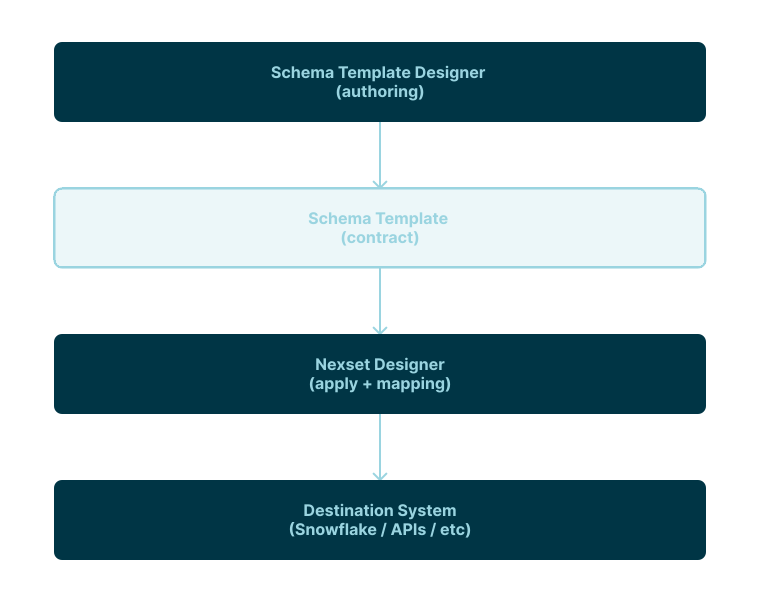
The conversation kept returning to the same two facts: customers were feeling the pain, and the team could not afford to overbuild.
"
I keep getting asked from a customer facing side of things is when is that getting solved?
Review sync (Saket Mike Niket 2025-05-14)
"
The preview is a problem that I keep getting from different customers, and we do need to fix it.
Review sync (Saket Mike Niket 2025-05-14)
"
I'm really kind of very hesitant on investing too much dev effort.
Review sync (Saket Mike Niket 2025-05-14)
context
5
This work lived inside a product area where schema rules, preview behavior, and mapping outcomes were tightly connected, but the implementation model was still fragmented. The design had to help operators, contract authors, and customer-facing teams reason about the same workflow without pretending the underlying complexity did not exist.
approach
6
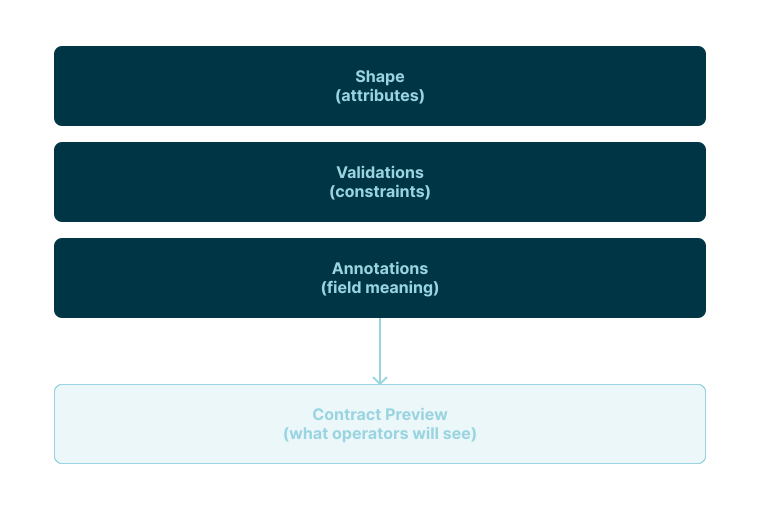
I treated the work as a scope exercise first: identify the minimum set of workflow decisions that would reduce customer pain and still be buildable quickly. That meant defining what should be explicit in the UI, what should remain read-only, and where existing JSON-based patterns were more valuable than inventing a richer but riskier interface.
discovery-and-evidence
7
The strongest signals came from repeated review conversations that tied preview confusion to actual customer-facing pain and to engineering-effort concerns. The team was explicit that solving the wrong problem elegantly would still be a miss if it consumed too much development time or created a workflow we would need to undo later.
implementation
9
The implementation direction stayed intentionally small: reuse existing guided and JSON-based patterns, define the contract workflow explicitly, and avoid a broad coupling between every authoring and preview surface. That gave engineering a tighter target and lowered the risk of backing into a more expensive redesign later.
Directional outcomes now; explicit success measures next.
reflections
11
The lesson I would carry forward is that strong information architecture is often a scoping discipline before it becomes a UI discipline. When customer pain, internal ambiguity, and dev effort all point in different directions, the design job is to define the smallest workflow that can earn trust and still move the business forward.
appendix
12
Context/Schema Template Designer transcriptsSaket Mike Niket 2025-05-14.diarized.txt plus the UX-Design-Sync-* files that clarified apply, preview, and authoring tradeoffs